
BARNEY’S FARM SALE – UNLIMITED BUY 1, GET 1 – CHOOSE FROM 5 TOP STRAINS AT CHECKOUT
⬤
BARNEY’S FARM SALE – UNLIMITED BUY 1, GET 1 – CHOOSE FROM 5 TOP STRAINS AT CHECKOUT
⬤
BARNEY’S FARM SALE – UNLIMITED BUY 1, GET 1 – CHOOSE FROM 5 TOP STRAINS AT CHECKOUT
⬤
BARNEY’S FARM SALE – UNLIMITED BUY 1, GET 1 – CHOOSE FROM 5 TOP STRAINS AT CHECKOUT
⬤
BARNEY’S FARM SALE – UNLIMITED BUY 1, GET 1 – CHOOSE FROM 5 TOP STRAINS AT CHECKOUT
⬤
BARNEY’S FARM SALE – UNLIMITED BUY 1, GET 1 – CHOOSE FROM 5 TOP STRAINS AT CHECKOUT
⬤
G13 Haze – Regular
Regular Seeds
Various Quantities
$32.00 – $115.00Price range: $32.00 through $115.00


G13 Haze – Regular by Barney’s Farm — regular seeds. You bring a modern legend into your garden with G13 Haze regular. Whether you believe the rumors that G13 was bred by government agencies or not, its potency is undeniable. Up to 23% THC.
G13 Haze – Regular by Barney’s Farm is a regular strain bred from G13 x Hawaiian Sativa. It tests at up to 23% THC with an 80% sativa / 20% indica profile. You bring a modern legend into your garden with G13 Haze regular. Whether you believe the rumors that G13 was bred by government agencies or not, its potency is undeniable.
G13 Haze – Regular grows to 110 cm indoors and 150-180 cm outdoors. Flowering takes 65-70 days. Indoor yields reach around 600 g/m², and outdoor plants can produce up to 800 g/plant. Outdoor harvest falls in October (2nd–3rd week).
G13 Haze Regular by Barneys Farm
You bring a modern legend into your garden with G13 Haze regular. Whether you believe the rumors that G13 was bred by government agencies or not, its potency is undeniable. Choosing regular seeds allows you to explore the genetic interplay between the heavy, mysterious G13 and the uplifting Haze.
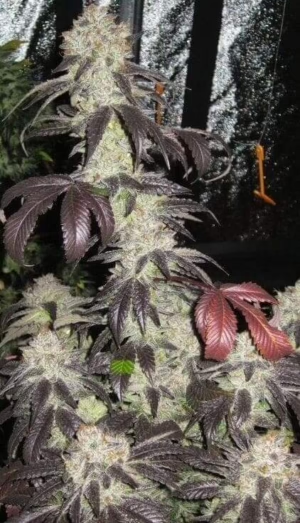
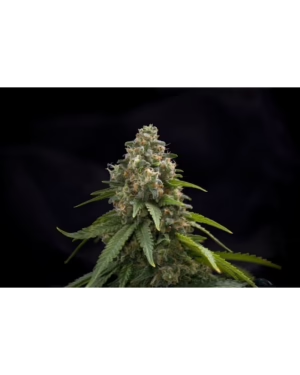
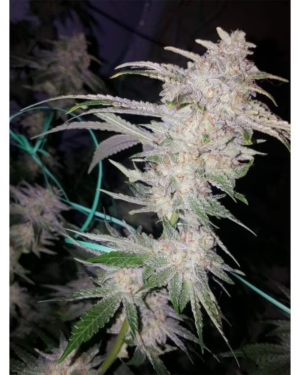
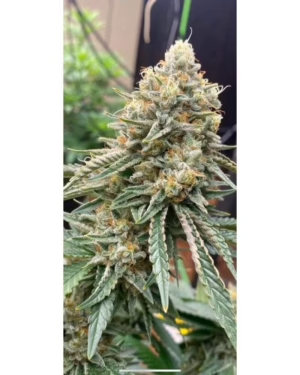
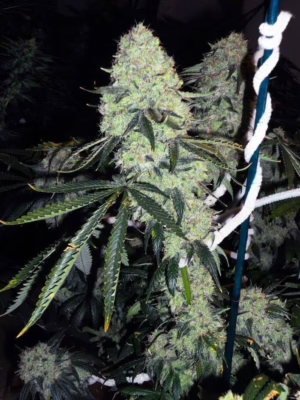
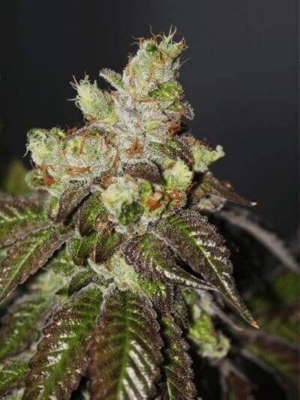
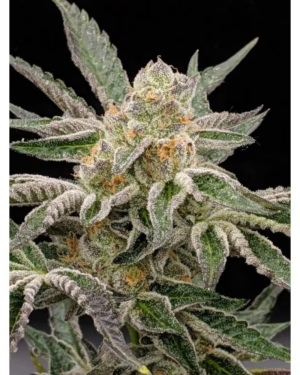
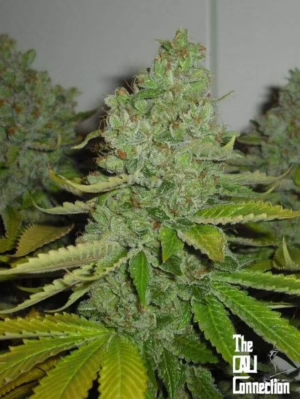
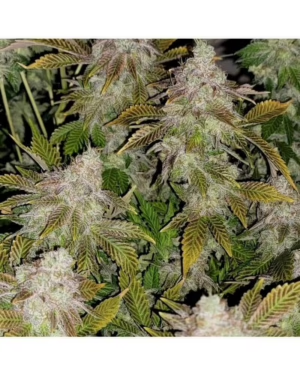
This is a breeder’s delight, offering you the chance to isolate phenotypes that combine the best of both worlds: massive Indica density with a soaring Sativa high. Unlike many Hazes that grow wild and lanky, G13 Haze remains surprisingly compact and manageable. The buds are incredibly dense and heavy, showcasing the G13 influence, while the plant structure retains Sativa elegance.
Expect high resin production, making the flowers sticky to the touch. The aroma is a tropical vacation in a bud, bursting with scents of sweet fruit and citrus. Underlying the fruitiness, you will find spicy, herbal notes that add depth and complexity.
It is a fresh, invigorating scent that energizes your senses before you even take a taste. The flavor profile mirrors the aroma, delivering a delicious mix of candy-like sweetness and tropical fruit salad. Notes of pine and spice become apparent, preventing the sweetness from becoming overpowering.
It is a mouth-watering profile that leaves a crisp, fruity sensation. G13 Haze delivers a powerful “creeper” high that starts with a cerebral lift and intensifies over time. You will experience a rush of euphoria, creativity, and motivation, making it an excellent daytime strain.
The G13 genetics provide just enough physical relaxation to keep the jitters away without slowing you down. This strain is a miracle if you are a Sativa lover with limited space. It stays short for a Haze but yields like a monster, making it ideal for your SOG and ScrOG gardens.
Regular seeds provide the vigor needed to support the heavy, dense buds that this strain produces, ensuring a bumper crop every time. Flowering is completed in a reasonable 65–70 days. Indoors, plants remain compact at 100–110cm and yield a heavy 500–600g/m².
Outdoors, plants can reach 150cm and yield up to 800g per plant, ready for harvest by mid-October. THC levels are high at 23%.
These are regular seeds from Barney’s Farm, one of the world’s most decorated cannabis seed banks. Every G13 Haze – Regular seed is bred for consistency, potency, and genetic authenticity. Orders ship discreetly from our US distribution center in California.
G13 Haze – Regular – FAQ – Frequently Asked Questions
G13 Haze – Regular by Barney’s Farm is 80% Sativa and 20% Indica.
G13 Haze – Regular by Barney’s Farm tests at up to 23% THC.
G13 Haze – Regular is a cross of G13 x Hawaiian Sativa.
Indoors, G13 Haze – Regular grows to 110 cm. Outdoors, plants can reach 150-180 cm.
Indoors, G13 Haze – Regular yields up to 600 g/m². Outdoors, plants can produce up to 800 g/plant.
G13 Haze – Regular has a flowering time of 65-70 days. Outdoor plants are typically harvested in October (2nd–3rd week).
Store G13 Haze – Regular seeds in a cool, dark place in an airtight container, ideally in a refrigerator. Avoid freezing and make sure they are properly labeled and dated.
Germinate at 70-90 degrees F (21-32 degrees C). Below 70F can delay or stop germination; above 90F can cause poor germination and increase the risk of seedlings drying out.
If allowed in your location, we recommend the paper towel method: place seeds between damp paper towels, keep them warm and dark, and check daily to ensure the paper towel stays moist.
Once germinated, transfer to soil or similar grow media, making a small hole 5-10 mm deep. Gently place the sprouted seed root-down in the hole. Use a match or toothpick rather than handling with your fingers.
No. Start in smaller pots and gradually move to larger containers as the root structure develops. Smaller pots dry out more quickly, which encourages roots to spread in search of moisture and nutrients. Incrementally increasing pot size stimulates new root growth and allows for more precise watering and feeding.
Seed Germination Instructions
for cannabis seeds

Step 1: Soak the seeds
- Fill a glass with clean, room-temperature water (68-77°F / 20-25°C).
- Use filtered, dechlorinated, or pH-balanced water to prevent contaminants.
- Drop the seeds into the water and gently swirl to ensure full submersion.
- If seeds float, tap them down lightly or leave them to absorb water.
- Optional: Add 3% hydrogen peroxide (H₂O₂) at a ratio of 1 ml per 100 ml of water to prevent mold and bacteria.
- Place the glass in a dark, warm location for 2-6 hours (do not exceed 12 hours to prevent drowning).

Step 2: Prepare the Germination Plate
- Dampen two layers of paper towel, cotton, or thick toilet paper with clean, dechlorinated water.
- If using toilet paper, fold multiple plies to ensure adequate thickness.
- Place seeds evenly between the layers, ensuring they do not touch each other.
- Towels should be moist but not soaking wet.
- Set the damp towel on a plate and cover with another plate or place it inside a resealable plastic bag to retain moisture.
- Store in a dark, warm location (70-78°F / 21-26°C) such as a drawer or cabinet.
- Check the moisture level every 6-12 hours and add water as needed to prevent drying.
- Expected Germination Time:
- Most seeds crack open within 48-72 hours.
- Some may take 5-6 days to show taproots.
- Older seeds or seeds with a tougher shell may take up to 10-15 days to sprout.
- If a seed has not sprouted within 10 days, gently check it for signs of swelling or softening.

Step 3: Monitor Germination
- Seeds typically crack open and develop a taproot within 48-72 hours, but some may take up to 5-6 days.
- Older or dormant seeds may take 10-15 days to sprout, especially if they have a thicker shell.
- Check regularly for signs of mold or fungal growth.
- If mold appears, replace the paper towel and rinse seeds in a diluted hydrogen peroxide solution (1 ml of 3% H₂O₂ per 100 ml water).
- The seed is ready for planting when the white taproot emerges and reaches ¼-½ inch (0.6-1.3 cm).

Step 4: Planting the Seeds
- Prepare a pH-balanced growing medium (pH 5.5-6.0) such as:
- Quality soil-perlite mix
- Coco coir with perlite
- Rockwool cubes (must be pre-soaked in pH 5.5 water)
- Plant the seed 2-5 mm deep, with the root tip facing downward.
- Use containers that are at least 10 cm (4 inches) deep with drainage holes for healthy root development.
- Lightly cover the seed with soil—do not press down too hard.
- Spray the top layer with water instead of drenching it.

Step 5: Initial Care for Seedlings
- Keep the growing medium moist but not waterlogged—spray with a spray bottle instead of overwatering.
- Maintain high humidity by:
- Covering containers with clear plastic wrap or a humidity dome.
- Ensuring there is some airflow to prevent mold buildup.
- Place seedlings under cold white LED or fluorescent lights or in indirect sunlight at 68-77°F (20-25°C).

Step 6: Gradual Exposure to Light
- Once seedlings emerge and develop their first set of leaves (cotyledons):
- Slowly introduce them to stronger light sources.
- Start with low-intensity LED, CFL, or indirect sunlight, then gradually increase exposure.
- Keep grow lights at a safe distance:
- LEDs: 12-24 inches (30-60 cm) above seedlings.
- HPS/MH: 24-36 inches (60-90 cm) above seedlings.
- If transitioning to outdoor sunlight:
- Harden seedlings off gradually by placing them outside for short periods each day.

Additional Tips
- Use filtered rainwater, bottled water, or dechlorinated tap water.
- Maintain humidity levels between 70-80% for optimal germination.
- Avoid handling the taproot directly, as it is delicate and can be easily damaged.
- If using rockwool cubes, pre-soak them in pH 5.5 water before planting.
- Germination rates depend on strain genetics, seed age, and storage conditions.
Seeds may take longer to sprout if conditions are too dry, cold, or hot.
Failure to follow these steps may reduce germination success and replacements are unlikely.
By following these steps, you’ll achieve healthy, vigorous cannabis seedlings ready for strong growth. 🌱