

ETHOS Genetics: Who They Are, What They Breed and How Their Seed Lines Differ
ETHOS Genetics is a cannabis seed breeder based in Denver, Colorado, founded by Colin Gordon in 2014. ETHOS is well known for extensively working its


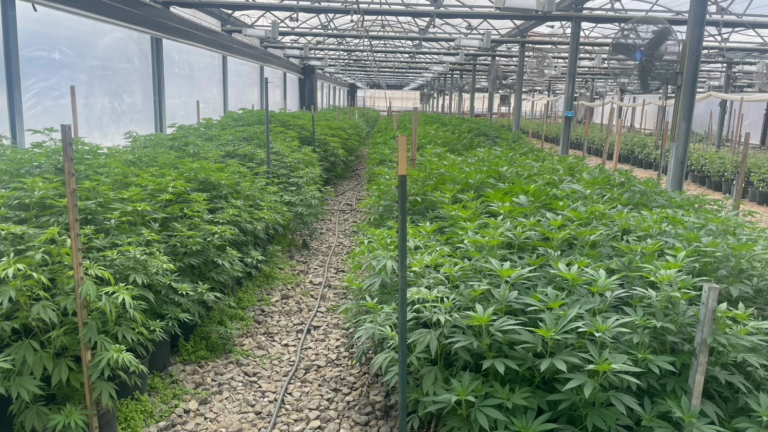
The cannabis industry is changing fast — biologically, technologically, and legally. For growers, the future of cannabis clones is at the center of this transformation. Clones remain the most reliable starting point for consistent genetics, faster harvests, and repeatable results. In 2025 and beyond, expect clean-stock programs powered by tissue culture, AI-assisted phenotyping, and policy shifts that could reshape economics from top to bottom.
Below, we map the major trends driving the future of cannabis clones, and what they mean for home cultivators and commercial operators alike.
Hemp framework remains the legal anchor. Under the 2018 Farm Bill and the USDA’s Domestic Hemp Production Program (finalized in 2021), the federal definition of hemp centers on ≤0.3% delta-9 THC by dry weight. That rule underpins licensing/testing frameworks and continues to guide plant materials that qualify as hemp. GovInfo
Seeds & tissue culture clarity. In 2022, the DEA confirmed that cannabis seeds and tissue culture (and other genetic material) are not controlled under the CSA if they meet the ≤0.3% delta-9 threshold — a key interpretation for clean-stock clone pipelines built on meristem and tissue culture. Marijuana Moment | Omar Figueroa
THCA guidance. In 2023, DEA correspondence clarified that THCA counts toward the hemp threshold when considered on a dry-weight basis (because it converts to delta-9 THC when heated). This nuance matters for producers and shippers who rely on hemp compliance at early growth stages. Marijuana Moment
Possible rescheduling & economics. Federal rescheduling (moving cannabis from Schedule I to Schedule III) has advanced through formal rulemaking steps and would remove IRS 280E penalties, letting state-legal businesses deduct normal expenses — a seismic shift for margins and reinvestment into better genetics and clone infrastructure. While timelines remain fluid, the core impact on taxes and financing is widely acknowledged in mainstream coverage and legal analysis. Reuters | Duane Morris | MarketWatch
Bottom line: The legal scaffolding increasingly rewards standardization and documentation — exactly where clones, tissue culture, and clean stock shine.
The single biggest biological story of the last few years is Hop latent viroid (HLVd) — a stealth pathogen linked to stunted growth, terpene loss, and reduced yields. Surveys and subsequent literature report high contamination rates, prompting a sea change in how elite genetics are maintained and distributed. Cannabis Business Times | MDPI
Tissue culture + thermotherapy have emerged as leading tools to eliminate HLVd from elite cultivars, restoring vigor and output. Recent peer-reviewed work and preprints show meristem-tip culture with heat treatment can clear the viroid in multiple cultivars — the basis for “clean mother” programs and pathogen-free clone production. SpringerLink | BioRxiv
Meanwhile, new reviews describe scalable micropropagation pipelines and improved regeneration protocols — the practical backbone of mass, clean clone supply. Expect more nurseries to adopt tissue culture as standard rather than a boutique add-on. ScienceDirectFrontiers
What it means for growers:
The cultivation floor is shifting from legacy lighting to LED-first. Industry research shows LED adoption across commercial indoor and greenhouse operations exceeded 70% by 2023 — a massive jump from the mid-2010s — with momentum continuing through 2025. Beyond energy savings, LEDs enable spectrum control, tighter DLI/PPFD targeting, and lower HVAC loads in well-designed rooms. Cannabis Business Times
Government and industry resources also emphasize the efficiency and economics of modern horticultural lighting, including rebates and best-practice standards — all of which benefit clone-driven programs that depend on meticulous veg environments. The Department of Energy’s Energy.gov | LEDuEducation
What it means for clones:
The next edge is computer vision + machine learning applied to cannabis plants — from seed/phenotype identification to disease detection and growth analytics. Recent academic work demonstrates deep-learning approaches for classifying seed varieties and detecting stress, while broader plant-science reviews outline best practices for AI phenotyping at leaf and canopy scales. MDPIarXivOxford Academic
Expect nurseries and large grows to deploy:
For growers, this translates to clone lots with measurable, verifiable uniformity — and fewer surprises.
As compliance tightens, documentation + packaging matter more than ever. USPS updated Publication 52 (2019) with hemp-related mail standards, and while producers remain responsible for compliance, the policy clarity has helped normalize shipping workflows for compliant plant materials and derivatives. (Always verify current carrier policies and keep records.) USPS
On the packaging side, expect continued innovation: moisture-stable plugs, insulated inserts, breathable liners, and shock-resistant trays — all aimed at maximizing clone survival and reducing claims. Combined with clean stock and faster courier lanes, 2025+ logistics will feel smoother and more predictable than the wild-west era.
Analysts have flagged 2025 as a transformative year: potential rescheduling could unlock standard tax deductions (no 280E), expand banking access, and improve profitability — though timelines and final details remain in flux. Even discussions alone are changing capital planning and M&A assumptions across the space. Reuters | The Wall Street Journal | Investopedia
Clones benefit in any scenario because they:
If/when margins improve industry-wide, expect even more investment in clean propagation, tissue-culture labs, and mother-plant infrastructure — the upstream engine of consistent retail flower.
Here’s the likely template for leading clone providers by 2026–2027:
For growers, this means clone boxes that behave like predictable, premium inputs — not gambles.
For home growers
For commercial cultivators
The future of cannabis clones is cleaner, smarter, and more scalable. Tissue culture and meristem therapy are bringing a new normal to plant health. LEDs and environmental controls make clone performance more predictable than ever. AI will reduce variability and elevate QC. And policy shifts — whenever they land — could unlock capital to accelerate all of the above.
For growers, the takeaway is simple: clean genetics + controlled environments + good data will define winners in the next cycle. Start with the right clones, and the future looks very bright.
👉 Ready to modernize your grow? Explore our Clones for Sale and build your next harvest on a clean, consistent foundation.
ETHOS Genetics is a cannabis seed breeder based in Denver, Colorado, founded by Colin Gordon in 2014. ETHOS is well known for extensively working its
Short answer: buy rooted clones if you want a plant that goes straight into your medium and starts growing, and buy unrooted cuttings if you
Unrooted cuttings or rooted peat pellets, what a bulk order really costs at 20, 40 and 100 plants, how to prep your space, and how to vet a clone supplier.